
A practical Warrior Cats Clans of the Forest walkthrough: campaign order, early quests, combat, den crafting, ranks and the three modes.
Warrior Cats Clans of the Forest Walkthrough
There is no fixed step-by-step walkthrough for Warrior Cats: Clans of the Forest. The developers generate characters, quests and stories per playthrough, so one player's quest order will not match another's. What can be planned is the route around that randomness: pick a campaign, protect your Clan favour, build a coherent set of moves, and know when to leave a fight to forage and craft.
That is the approach this walkthrough takes. It is a route, not a transcript. Every system below comes from the Steam listing, the publisher's feature page or the developers' own interviews, and anything still undocumented is labelled as such.
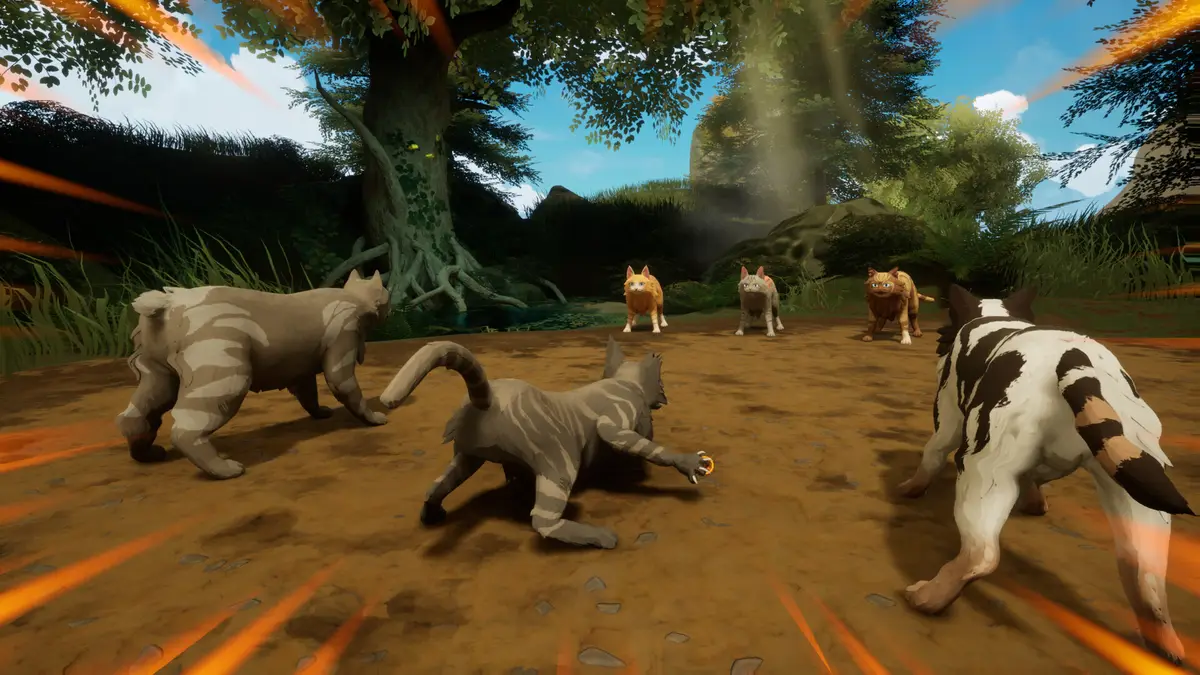
Start with one Clan campaign in Prophecy Mode, finish every quest you are offered, learn moves through story choices, keep one strong 3-cat setup, and clear a full run before switching modes. Do not chase a fixed quest list; the game does not use one.
Step 1: choose the campaign, not the "best" Clan
Clans of the Forest ships with four campaigns, one for each Clan: ThunderClan, RiverClan, ShadowClan and WindClan. The choice decides your home territory, your starting story and part of your base stats. No official source publishes a stat table or a difficulty ranking for the four, so there is no defensible "strongest Clan" answer.
| Campaign | Territory | What the choice changes |
|---|---|---|
| ThunderClan | Forest | Your starting questline, home camp and story cast |
| RiverClan | River territory | Same structure, different Clan politics and encounters |
| ShadowClan | Marsh and pine territory | Same structure, different rivals and quests |
| WindClan | Open moorland | Same structure, different routes and Clan relationships |
If you have no preference, ThunderClan is the campaign shown in the official gameplay trailer, which makes it the easiest one to compare against footage. That is a presentation reason, not a power reason. The four Clans and territories page covers each campaign in more detail.
Step 2: treat the opening as a tutorial, not a race
The first quest introduces the quest loop, the map and the combat screen. The official trailer shows the opening of the ThunderClan storyline, including the first quest, so ThunderClan players have the most preview material to compare against.
What to do in the opening hour:
- Follow the first quest marker until the game hands you a full party.
- Open the move list and read every move you own before the first serious fight.
- Forage and hunt on the way between markers rather than backtracking later.
- Craft the first den items when the option appears; bedding and a scratching post are the two confirmed items.
- Finish the opening questline before accepting every side quest on the map.
The last point matters because quests are generated. Accepting a dozen at once gives you a quest log you cannot read and no clear sense of which one advances your Clan. One chain at a time is easier to follow and easier to recover if you put the game down for a week.
Step 3: use quests to steer your move pool
Quests are not just experience. The developer interview with IGN states that your Clan, level and training shape your base stats, while the choices you make along the journey determine the moves you learn. That makes quest choices a build decision, not only a story decision.
Practical rules:
- Read the choice text before picking it. If one option sounds like a fighting lesson and another sounds like a diplomatic favour, they probably lead to different moves.
- Do not skip quest dialogue to save time. The choice is often in the conversation, not in a separate menu.
- Finish quest chains instead of abandoning them halfway. The reward structure is built around Clan favour and story progress.
- Accept that one run will not show all 75 moves. The pool is larger than a single campaign choice path can cover.
There is no published respec system, no move checklist and no confirmation that every move can be earned in one run. Treat each campaign as its own collection rather than trying to force a completionist route through a generated story.
Step 4: build a 3-cat team that can finish fights
Combat is turn-based, up to three cats against three enemies, with 75 unique moves and no spells. The tactical layer is the Stance system: every move you use changes your cat's Stance mid-fight, so the next move has to be read against the new state rather than repeated from a rotation.
A stable approach for the first campaign:
| Role | What it does | What to look for |
|---|---|---|
| Lead attacker | Applies pressure and forces enemy Stances | High-damage moves with a Stance you can follow |
| Support | Keeps the team alive or removes enemy pressure | Healing, buffs or debuffs that fit the lead's Stance |
| Flex | Covers the enemy type you meet most | A second damage type or a control move |
Focus one enemy at a time. A 3v3 fight is not a damage race; removing one enemy removes one set of actions from the turn order. Spread damage across all three and you give the enemy more turns to use its own Stance changes.
No official damage values, health totals or enemy stat tables have been published. Any page that gives you exact numbers for this game is guessing. The combat and Stances page explains the move system without inventing values.
Because Stances shift after every action, the enemy's previous move tells you what it is likely to want next. That is the closest thing this combat has to a tell, and it is more useful than a fixed rotation.
Step 5: do the between-fight work
The loop is not combat followed by more combat. The publisher describes foraging, hunting birds, rabbits and squirrels, crafting den items and solving environmental puzzles as part of the same run. Foraging supplies materials; hunting supplies prey; crafting turns both into den upgrades and gifts.
The confirmed crafting output is slim: bedding and a scratching post. There is no published recipe list, material table or price list. That means the correct behaviour is to pick up everything and check the crafting menu, not to follow a farming route someone invented.
Den crafting also feeds the asynchronous social layer. Players can visit each other's dens, and materials can be gifted. If you plan to use Skirmish Mode, a developed den is part of the presentation, even though it is not a combat stat.
Step 6: progress through the ranks
Progression is stated as three inputs: Clan, level and training. Rank is the visible expression of that progress. The publisher says you rise through the warrior ranks while your actions shape relationships, rivalries and reputation, and that this contributes to your Clan's growth.
No official source gives a rank list, an XP curve or a level cap. The practical route is therefore simple: keep completing quests, keep training the moves you actually use, and do not expect a number to tell you when you are ready for the next story beat. The story gates are the real milestones.
Each of the four campaigns is a separate story with its own prophecy, rivals and challenges. Progress does not automatically carry from one campaign to another in the way a New Game Plus would; the game is built around multiple runs, each populating the forest with its own set of stories.
Step 7: choose the right mode at the right time
| Mode | When to play it | What it tests |
|---|---|---|
| Prophecy Mode | First, and for the main campaign | Questing, exploration, crafting and story battles |
| Defender Mode | After you understand Stances and have a finished team | Survival against the game's fiercest enemies in one run |
| Skirmish Mode | Anytime, including between campaigns | Asynchronous PvP, den visits and gifting |
Prophecy Mode is the campaign. Defender Mode strips the loop down to a single run and a boss-rush structure. Skirmish Mode is the asynchronous online layer, with no requirement that both players are online. Starting with Defender before you understand Stance chains is the most common way to bounce off the combat.
A practical walkthrough checklist
- Pick one Clan and stay with its campaign until the story reaches a natural pause.
- Clear the opening quest chain before exploring the wider map.
- Read every choice line; moves are tied to story decisions.
- Build one lead, one support and one flex cat rather than three damage dealers.
- Focus one enemy per turn and respond to the enemy's last Stance.
- Forage and hunt on the way to objectives, not on dedicated farming trips.
- Check the crafting menu after every new material.
- Finish a campaign before judging the game's difficulty; Defender is a different test.
- Ignore tier lists and damage tables until the developers publish numbers.
- Back up your save before starting a second campaign; the save system has no slot browser.
What this walkthrough cannot tell you
It cannot give you a quest order, a boss list, a damage table or a best-Clan ranking, because none of those are fixed or published. The game generates quests and stories, the store page does not list bosses, and the developers have not released combat numbers. The honest walkthrough is a set of decisions that survive the randomness, which is what the steps above are.
FAQ
Is there a full walkthrough for Clans of the Forest?
No fixed one exists. Characters, quests and stories are procedurally generated, so a quest-by-quest guide would only describe one playthrough. This page covers the route that stays useful across runs.
How long does one campaign take?
No official playtime has been published. The game has four campaigns and generated quests, so a single completion time would not hold for the next player either.
Which Clan is best for a first run?
There is no published stat ranking. ThunderClan is the campaign shown in the official gameplay trailer, which makes it the easiest to compare with footage, but that is not a power recommendation.
Can I learn every move in one playthrough?
Not confirmed. There are 75 moves and your story choices determine which ones you learn. No official source says a single run can unlock the full pool.
Does progress carry between campaigns?
No New Game Plus or campaign carry-over has been announced. Each campaign is its own story with its own cast and challenges.
Is there co-op in the campaign?
No. The campaign is single-player. The online layer is asynchronous Skirmish battles and den visits, not shared-story co-op.
Sources
- Warrior Cats: Clans of the Forest on Steam - features, modes and store description
- Trailmark Games: Warrior Cats: Clans of the Forest - publisher feature list
- IGN: Clans of the Forest interview - Clan, level and training stats; choices determine moves
- Official gameplay trailer - ThunderClan opening footage
More Warrior Cats: Clans of the Forest Guides
Warrior Cats: Clans of the Forest is a licensed turn-based RPG from Bamtang Games and Trailmark Games, launching 23 October 2026 with four Clan campaigns.
Clans of the Forest age rating for parents: the ESRB Everyone 10+ label, how much violence there is, the scar toggle, and what younger fans should expect.
Start of Clans of the Forest: create and name your Warrior Cat, pick one of four Clans, rise from apprentice to warrior while foraging, crafting and hunting.
The Clans of the Forest cat creator offers millions of combinations: fur, patterns, colours, tails, whiskers, ears, eyes and markings, on a cat that ages.
Clan ranks in Clans of the Forest: starting as an apprentice, the ranks you can reach, medicine cats, and why the game has no classes to choose.
Clans of the Forest combat is turn-based 3v3 with 75 unlockable moves and no spells - depth comes from shifting combat Stances that every move changes.
Where to download and play Clans of the Forest now that it is out: every official storefront, the PC install size, and how to spot fake free-download pages.
Clans of the Forest costs $29.99 standard or $39.99 Feral Edition on console and $39.58 as a Steam bundle. The Feral Edition is the game plus the Prophecy Pack.